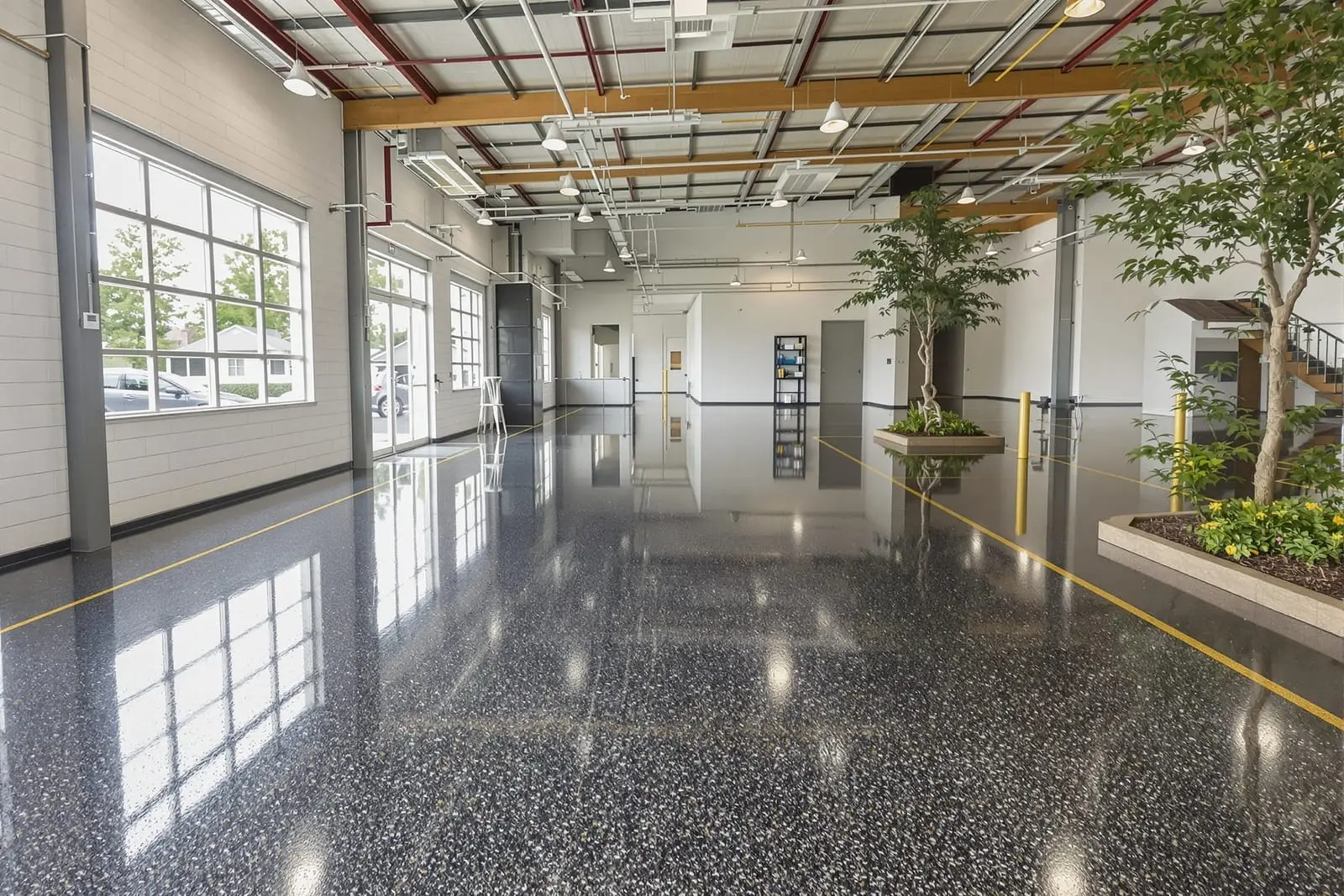
We install warehouse and industrial concrete floors in Smyrna, TN designed for forklifts, pallet racks, and heavy equipment. Our slabs are engineered for load capacity, flatness, and joint performance. We use proper reinforcement, mixes, and curing practices to reduce cracking and curling. Outfit your facility with floors that stand up to demanding operations over the long term.
Primetime Concrete Smyrna provides professional industrial concrete floors throughout Smyrna, TN and the surrounding area. Our licensed, insured crew delivers safe, clean, on-time work with a free estimate before anything begins. Call (615) 903-0027 or request your free quote.
Industrial concrete floors built for real warehouse use in Smyrna
Warehouse and industrial concrete floors have to hold up to forklifts, pallet jacks, racking, and constant traffic. At Primetime Concrete Smyrna, we build floors around how your operation actually works, not just what looks good on paper.
When we walk your Smyrna warehouse or industrial site, we look at the equipment loads, rack layout, traffic patterns, and where moisture or temperature swings are likely. A light manufacturing shop off Nissan Drive needs a different slab than a high‑bay distribution warehouse near I‑24. We match slab thickness, reinforcement, and joint layout to those real loads so you get a floor that stays serviceable for years instead of cracking early.
Middle Tennessee soil and weather matter too. Smyrna clay can move when moisture changes, and our winters bring freeze-thaw cycles, even if they are short. We account for that with proper subgrade prep, drainage, and mix design so your floor holds up through humid summers and cold snaps without heaving or spalling.
How we install warehouse and industrial floors step by step
A durable industrial concrete floor starts with what you do before the truck shows up. First, we evaluate and prepare the subgrade. That means proof‑rolling the base with equipment to find soft spots, undercutting and replacing weak soil if needed, then installing and compacting a crushed stone base to the right thickness. In Smyrna, we pay close attention to drainage, since heavy summer rains can saturate the ground and weaken an unprotected base.
Once the base is tight and graded, we set forms and layout control joints, column pads, and thickened slab areas. At this point we also place vapor barrier if you need it, which is common under slabs that will get coatings, VCT, or storage where moisture-sensitive product is stored. For most warehouse floors we recommend a high quality 10 to 15 mil vapor barrier, properly taped and protected from punctures during rebar or dowel installation.
Reinforcement comes next. Depending on your needs and budget, this might be rebar mats, dowel baskets at construction joints, or structural fiber reinforcement in the mix. Heavy racking or point loads often call for both rebar and dowels to control cracking and load transfer. Primetime Concrete Smyrna designs reinforcement with your engineer or ours so it matches the actual rack layout and equipment path instead of using a one-size approach.
On pour day, we place concrete using laser screeds or vibratory screeds where possible for flatness, followed by bull floating and edging. Timing the finishing is critical in Middle Tennessee weather, since high humidity can slow set in spring while summer heat speeds everything up. We monitor surface moisture and bleed water, then power trowel in multiple passes to reach the finish level you need, from a smooth hard‑troweled surface for forklifts to a slightly textured finish where slip resistance matters. Finally, we cut or form control joints at planned locations and apply curing compound or start wet curing to lock in strength and reduce early shrinkage cracking.
Concrete mix, finishes, and coating options for industrial use
Industrial concrete floors are not all the same mix. For warehouses in Smyrna, we commonly use a 4,000 to 5,000 psi concrete with a low water‑cement ratio for durability. For cold storage or areas that will see deicing chemicals, we may specify air‑entrained concrete to better handle freeze-thaw cycles. We also discuss adding steel or synthetic fibers where impact and load transfer are concerns.
Finish and surface treatments depend on how you use the space. A distribution warehouse with constant forklift traffic usually benefits from a hard‑troweled finish, then optional densifier and sealer. A lithium or sodium silicate densifier penetrates the slab, tightens the surface, reduces dusting, and improves abrasion resistance, which is helpful for high‑traffic routes between dock doors. In some manufacturing spaces, a slightly broomed or micro‑profiled surface may be better for slip resistance around wet processes.
Primetime Concrete Smyrna can also coordinate with floor coating contractors if you want epoxy, urethane, or line striping installed after the slab cures. If coatings are planned, we adjust the mix and finishing to avoid over‑troweling, which can create a very tight surface that is harder for coatings to bond to. For areas where you plan to anchor machinery, we can cast in conduits, embed plates, or form machine pads with extra thickness so future drilling and anchoring does not compromise the slab.
Color and appearance are usually secondary for industrial floors, but they still matter in offices, showrooms, or open manufacturing where customers visit. We can discuss integral color or stained and polished sections near entries or office tie‑ins, while keeping the main warehouse floor optimized for performance and easy maintenance.
What affects cost and schedule for warehouse & industrial slabs
Owners in Smyrna usually want to know why one bid for industrial concrete floors is higher than another. The main drivers are slab thickness, reinforcement type, floor tolerance requirements, and site conditions. A 6‑inch slab with mesh and minimal flatness requirements will cost less than an 8‑inch slab with rebar, dowel baskets, and F‑number flatness for high‑bay narrow‑aisle racking.
Subgrade conditions can change pricing too. If your site was recently graded and has a good stone base, preparation is faster and cheaper. If we find soft, pumping subgrade or poor drainage, we may need to undercut and replace soil, add more stone, or install drains that protect your investment long term. Given Smyrna’s mix of older industrial buildings and new tilt‑wall construction, we tailor our approach to whether we are replacing a floor in an existing building or pouring in a new shell.
Schedule is another key factor. Large monolithic pours for big warehouses are more efficient but require coordination with other trades and material deliveries. Hot summer afternoons in Smyrna can shorten finishing time, so we might schedule pours in the early morning or evening to maintain quality. In cooler months, we consider set times and potential cold weather measures like blankets or temporary heat. Primetime Concrete Smyrna will walk you through the trade‑offs between speed, cost, and performance so you can make an informed choice instead of just chasing the lowest price.
We also remind owners to budget for curing time. Even though a slab can often handle light foot traffic within a day, we recommend specific waiting periods before heavy forklift traffic, racking installation, or coating application so the floor reaches enough strength and moisture conditions stay within manufacturer specs.
Common issues, repairs, and how to plan a project in Smyrna
Many industrial floors fail early not because concrete is a bad material but because someone rushed prep or ignored how the building would actually be used. Typical problems we see in Smyrna include random cracking where joints were spaced too far apart, curled slab edges from poor joint design, pop‑outs from contaminated aggregate or rapid surface drying, and spalling at dock doors from repeated impact. When Primetime Concrete Smyrna installs or repairs a floor, we address the root cause, not just the symptom.
For existing warehouses, we can assess whether grinding, joint rebuilding, partial slab replacement, or full replacement makes the most sense. Sometimes all you need is to rebuild and armor the joints, inject cracks where needed, and apply a densifier and sealer to control dust. In worse cases where the subgrade has settled or the original slab is too thin for your current loads, we may recommend removing and re‑pouring sections with thicker, reinforced concrete and better joint layout.
Planning ahead is the best way to avoid downtime. Before we start, we help you map out staging, access routes, and shut‑down areas so your Smyrna operation can keep moving. For 24‑hour or high‑throughput facilities, we often phase the work so one side of the warehouse remains open while we pour and cure the other. We also coordinate with electricians, plumbers, and racking installers so floor penetrations and anchor locations are known before we place the concrete.
If you are considering a new warehouse or upgrading an older industrial building in Smyrna, bring Primetime Concrete Smyrna in early during design. We can offer practical input on slab thickness, joint spacing, and reinforcement that matches how you plan to use the building, not just what looks typical on drawings. That early planning helps you avoid costly change orders later and results in an industrial concrete floor that supports your business for the long haul.
“
Professional warehouse & industrial concrete floors, done right the first time, quality materials, honest pricing, and results that last.
Primetime Concrete Smyrna
Warehouse & Industrial Concrete Floors Across Our Service Area